
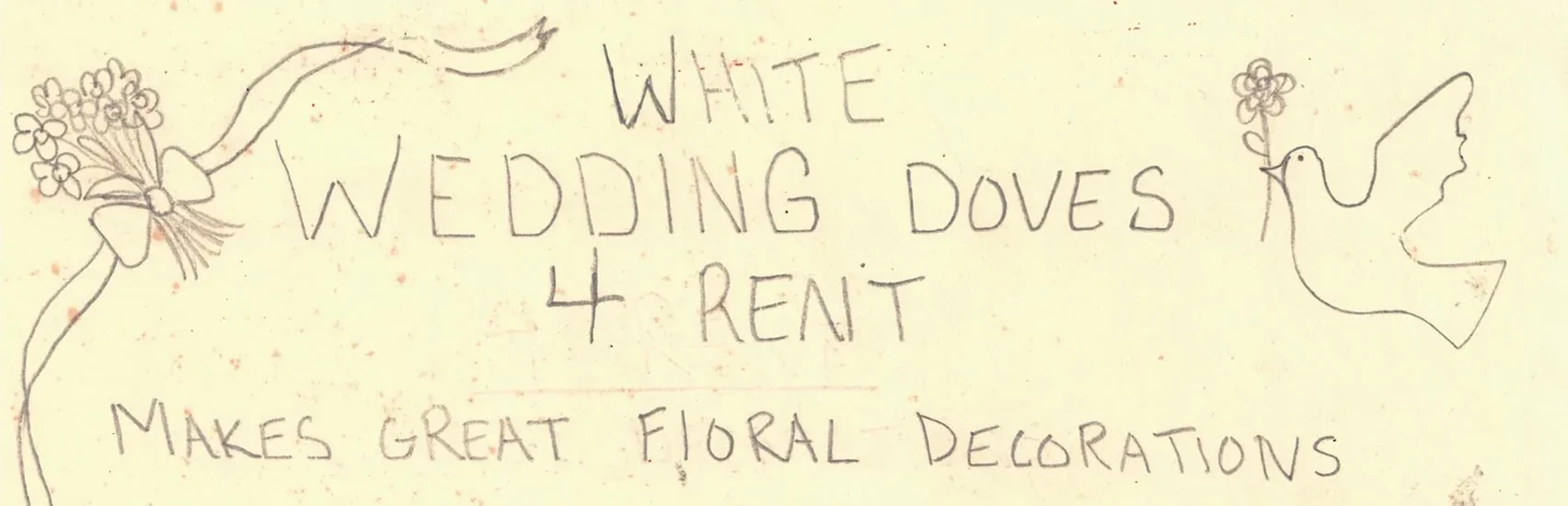
Growing up, we had an aviary outside the house full of white doves. I spent hours with them every day, taking care of them, making friends with them, and cooing right back at them. They weren't just pets. They were my friends.
When I was about eight, I found out my dad planned to eat them.
I took it the way any kid would. I climbed to the top of our triple-decker bunk bed (I was the only one who could be trusted that close to the ceiling fan) and cried into my journal. That day's entry still makes me laugh: "I ate bean soup. I rode my bike. Dad wants to eat my friends."
Somewhere between the tears, I realized crying wasn't going to save anybody. I had to do something.
So I set out to prove my birds could be a blessing to the family, not a burden. If they could earn their keep, they could stay.
I put together an offer to rent them out as decorations: two doves and a cage for $79.99 a day, four for $89.99, or six for $119.99. Where does an eight-year-old get numbers like that? From the best marketing he can find. Mine was a mailer lying around the kitchen, from a carpet cleaning company, I'm pretty sure. I copied their pricing right over: a $100 deposit, $25 for delivery, $25 for pickup, and no deliveries on Sundays.
I drew the flyers by hand. "White Wedding Doves 4 Rent. Makes great floral decorations." A dove in one corner, a birdcage and a bouquet in the margins, and my hours at the bottom: Monday through Saturday, 3 to 8 p.m. In other words, after school.

I put them up on Main Street. I'm pretty sure my parents had no idea what I'd done. But I was on a mission. My marketing had to work. For my friends, it was life or death.
Then the kitchen phone started ringing. Families wanted doves for quinceañeras, bodas, and pachangas, mostly from our Latino community. I'm still grateful to every one of them. The birds were never eaten.
Years later, two of those flyers came back to me. My father had kept them in his collection of memories, and after he passed, they were given back to me. The same dad who wanted to eat my birds had saved the flyers that saved them.
Looking back, that was my first lesson in marketing. I had a problem. I chose a strategy. I picked one tactic and put it where people would see it. And the phone rang. I didn't know what I was doing back then. I do now.
Nearly twenty years in agriculture later, I still see that order work every time: the problem first, then the strategy, then the tactics and tools. Most dealers I meet start with the tools, or worse, market just to check a co-op box.
Borrowed attention, built trust
My flyers went on Main Street for a reason. That's where people already were. I didn't have to bring anybody to me. I borrowed the attention of a street everybody walked down.
Every dealer does the same thing. The brands you carry have national reach, strong reputations, and good advertising. That gets a grower's attention, and it should.
But when a grower gets to the final decision, the brand isn't who they call. They call the dealer: the person who will quote it, install it, and pick up the phone when something breaks. That part of the trust can't be borrowed. It's built one install and one service call at a time.
So here's the first question. Whose name do growers see first? On your sign, your trucks, your shirts, and the banner at the ballfield, is it yours?
So how do you know if your marketing works?
I knew mine worked because the kitchen phone rang. Most dealers I talk to can't say for sure. Not because they aren't trying, but because they've never stopped to check. Start with three questions:
- Are new growers finding you? Ask your last few new customers how they first heard about you.
- Are your proposals closing? If people find you but don't buy, the problem isn't awareness.
- Are customers coming back and sending friends? If they aren't, the sale is where your marketing stops.
The answers tell you where growers get stuck. That's where your time and money should go.
Strategy, then tactics, then tools
Marketing that works follows the same order my doves did.
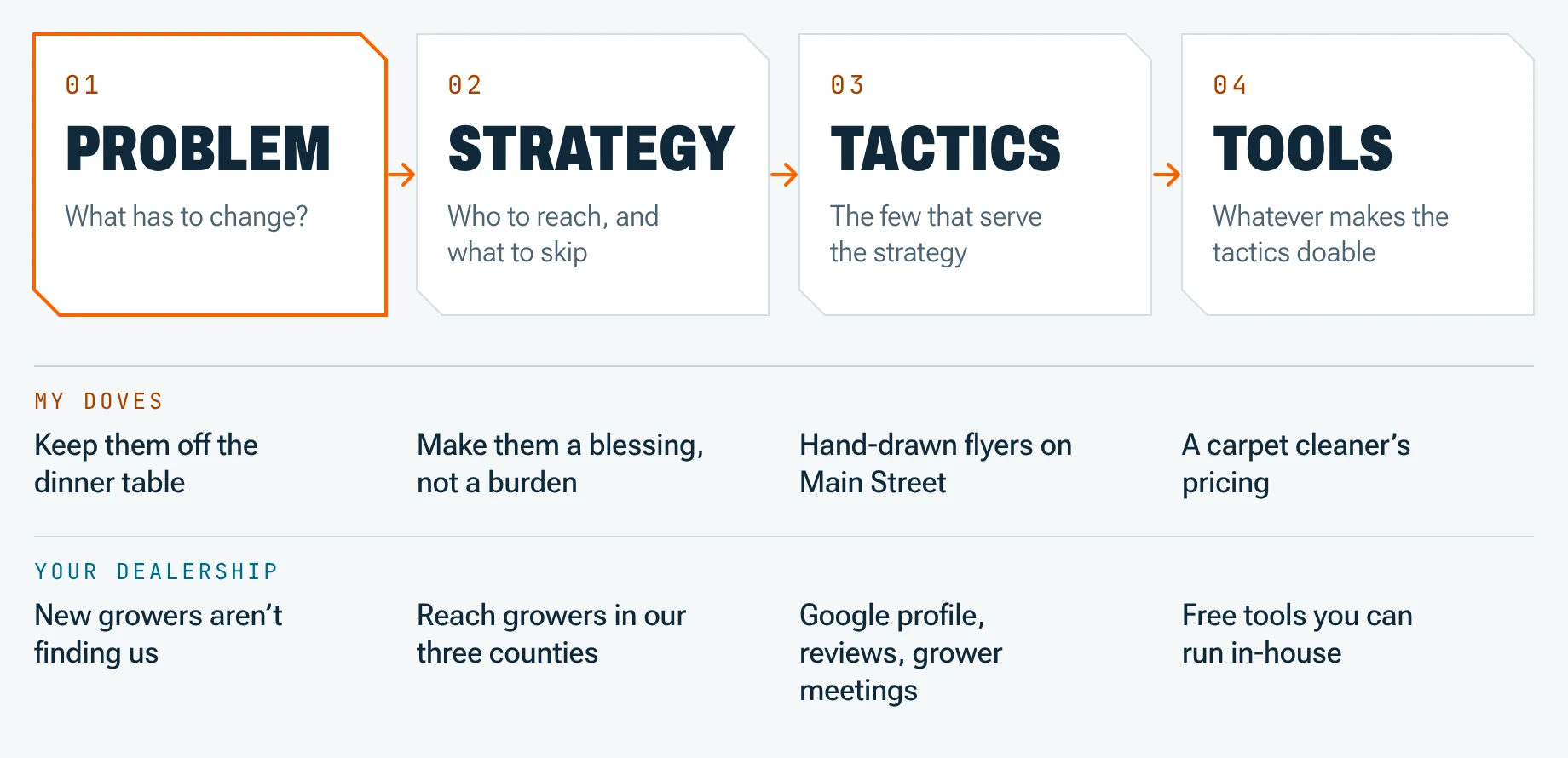
Start with the problem. Mine was simple: keep the birds off the dinner table. Yours might be new growers who don't know you, proposals that don't close, or customers who don't come back.
Then the strategy. Mine was to make the birds a blessing, not a burden. Yours is a decision about which growers you need to reach and what you need them to do. Strategy is also deciding what you won't do.
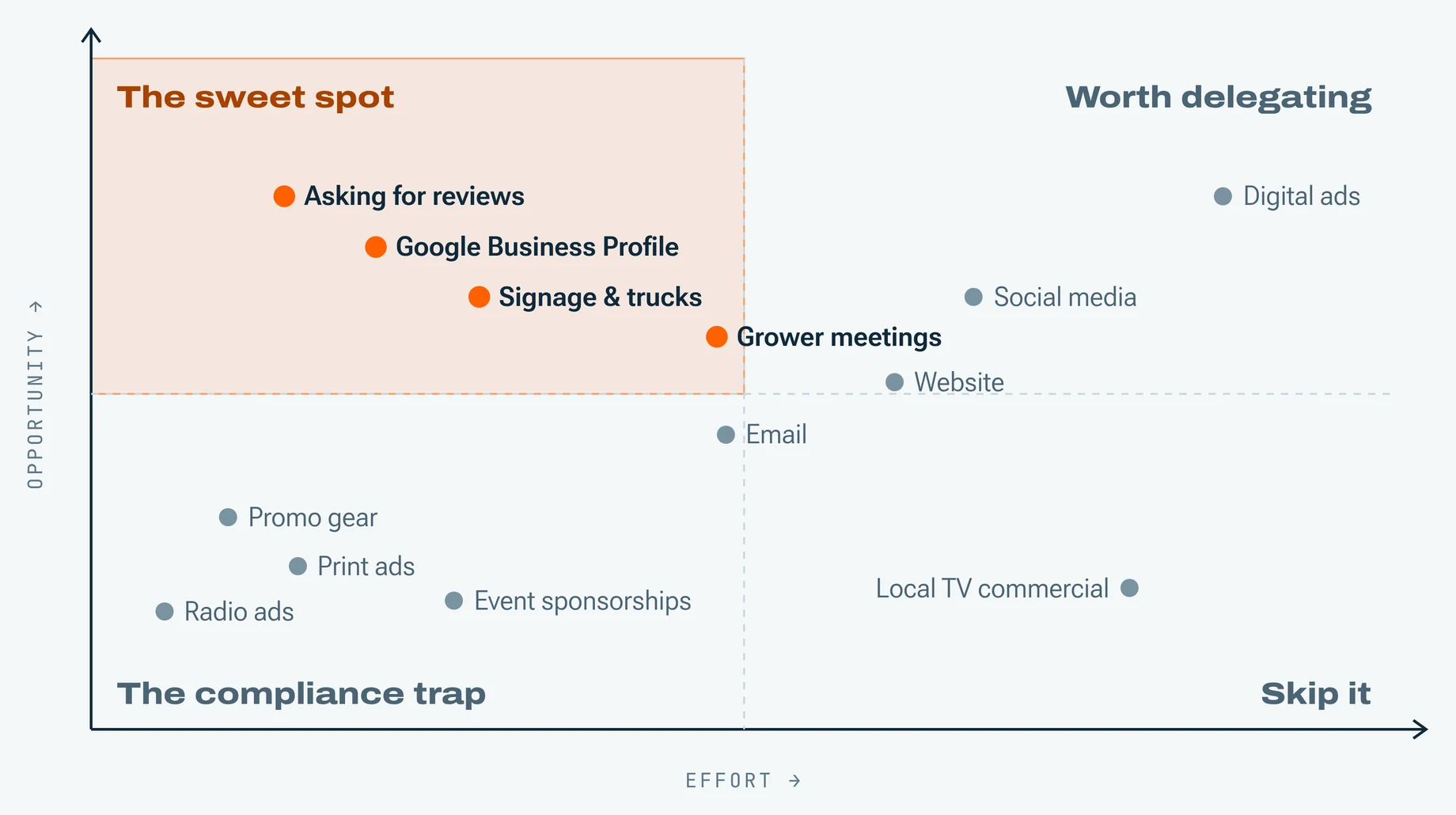
Then the tactics. I had one: flyers on Main Street. You have a mile-long list: radio, print, email, your website, reviews, grower meetings. Nobody can do all of it. Pick the few that serve your strategy, and start where the opportunity is high and the effort is low.
Tools come last. I drew mine by hand, and I borrowed my pricing from a carpet cleaner. Today there are free and cheap tools that let a small team do work that used to take an agency. Use them to run the tactics you chose, not to chase every new thing. And the best tool is one that serves you, not one you have to adapt to.
Your business isn't like any other
There's no template for marketing that works, because no two dealerships are the same. Your towns, your growers, your crew, and your story are your own. That's the part nobody else can copy, and it's the part worth putting your name on.
My doves never made it to the dinner table. A hand-drawn flyer and a kid with a reason to fight kept them off it. Your marketing doesn't have to be fancy to work, either. It has to start with the right problem.
Want to see where you stand? Take the dealer marketing self-check and score yourself in about five minutes.
Bailey AG was built to help rural businesses grow. The company works alongside ag retailers, suppliers, and rural businesses to build stronger brands and sharper messaging with practical go-to-market strategies.